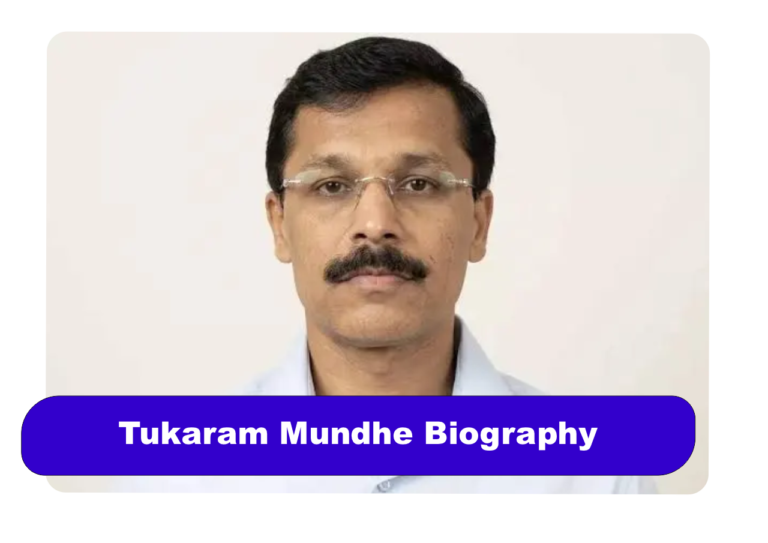
Tukaram Mundhe is a 2005-batch IAS officer from Maharashtra known for his fierce honesty, 25+ transfers, and relentless fight against corruption. Read his full biography.
Tukaram Haribhau Mundhe is widely regarded as one of India’s most upright and fearless civil servants. A 2005-batch IAS officer of the Maharashtra cadre, he has built a reputation over two decades for cracking down on corruption, cancelling illegal constructions, suspending errant officials, and refusing to bend to political pressure — no matter the consequences. His reward, more often than not, has been a transfer order.
Born into a farming family in rural Maharashtra, Mundhe cleared the UPSC Civil Services Examination securing an All India Rank of 20 — after years of failed attempts and relentless preparation. His story is one of grit, principle, and an almost stubborn commitment to public service that has made him both a hero to ordinary citizens and a thorn in the side of powerful politicians across party lines.
Quick Facts About Tukaram Mundhe
| Detail | Information |
|---|---|
| Full Name | Tukaram Haribhau Mundhe |
| Date of Birth | June 3, 1975 |
| Age | 50 years old (as of 2025) |
| Birthplace | Tadsona village, Beed district, Maharashtra |
| Nationality | Indian |
| Profession | IAS Officer (Indian Administrative Service) |
| Cadre & Batch | Maharashtra Cadre, 2005 Batch |
| UPSC Rank | All India Rank 20 (CSE 2004) |
| Current Posting | Secretary, Revenue and Disaster Management Department, Mumbai (since May 2026) |
| Total Transfers | 25 (in 21 years of service) |
| Wife | Archana Mundhe |
| Children | Agastya Mundhe (son), Ashana Mundhe (daughter) |
| Education | M.A. Political Science, UGC-JRF |
| Famous For | Anti-corruption drives, record transfers, honest governance |
Early Life: A Village Boy with a Big Dream
Tukaram Mundhe was born on June 3, 1975, in Tadsona, a small village in the Beed district of Maharashtra. He came from a progressive Vanjari farming family where life revolved around the land. His parents, Haribhau and Aasrabai Mundhe, were farmers who lived in a modest mud-brick house. Resources were scarce, but values were not. From the age of eight, Tukaram worked alongside his parents on the farm. His mornings began with fieldwork before school, and his evenings returned to it.
Tasks like fencing, well-digging, sowing, and selling produce were as familiar to him as textbooks. Far from being a burden, he later reflected that this upbringing gave him an empathy for ordinary people that would define his entire administrative career. The first beacon of inspiration in his life was his elder brother, Ashok Mundhe, who became the first graduate and civil servant from their village. Seeing his brother’s journey planted the seed of a dream in Tukaram’s mind — to serve the public through the Indian Administrative Service.
Education: The Long Road to Rank 20
Mundhe completed his early schooling at a Zilla Parishad school in his village, navigating the financial pressures of a farming household. He later pursued higher education in Aurangabad, earning a Bachelor’s degree in History and Social Science from Dr. Babasaheb Ambedkar Marathwada University, followed by a Master’s degree in Political Science, also qualifying for the prestigious UGC-JRF (Junior Research Fellowship). His path to the IAS was anything but straight.
He failed the civil services examination multiple times before clearing the Maharashtra Public Service Commission (MPSC) in 2001. He persisted, attempting the UPSC over several more years. On his final attempt, he cracked the UPSC Civil Services Examination 2004 with an All India Rank of 20 — a stunning result that validated eight years of relentless preparation alongside his early MPSC and state service career.
IAS Career: A Record of Action and Accountability
Tukaram Mundhe was appointed as Supernumerary Assistant Collector of Solapur on August 22, 2005. He made his intentions clear almost immediately — on just his fourth day in service, he raided and sealed a bar owned by a powerful local politician where illegal activities were taking place.
The tone was set for the career that would follow. Over the next two decades, Mundhe served across Maharashtra in roles spanning district administration, municipal governance, and state secretariat departments. As CEO of Nagpur Zilla Parishad (2008), he suspended absent teachers and doctors and cracked down on fund irregularities. As Municipal Commissioner of Navi Mumbai, he introduced strict civic enforcement, drawing protests from corporators who filed a no-confidence motion against him — which was stayed by the Chief Minister. As Municipal Commissioner of Nashik, he cancelled illegal constructions, demolished unauthorised structures, cracked down on unlicensed hawkers, and refused procurement favours to politically connected contractors.
When he was transferred out of Nashik, large crowds gathered outside the municipal headquarters to protest his removal. Citizens held the local guardian minister responsible for his transfer, while politicians across parties lobbied for it. His posting as Municipal Commissioner of Nagpur (NMC) in January 2020 was politically charged from the start. Appointed by the Uddhav Thackeray-led MVA government to head a BJP stronghold, Mundhe reportedly even hesitated initially, wary of appearing politically motivated.
He proceeded regardless, launching investigations into long-standing irregularities and once again earning citizens’ praise and politicians’ wrath in equal measure. Across his career, Mundhe developed a three-point checklist to guide every decision: Is it legal? Is it ethically correct? Is it in the public interest? If the answer to all three was yes, he acted — regardless of who stood in the way.
The Transfer Phenomenon: 25 Postings in 21 Years
No element of Tukaram Mundhe’s career has drawn more attention than his extraordinary record of transfers. By 2026, he had accumulated 25 documented postings across 10 locations in just 21 years of service. In Maharashtra’s bureaucratic circles, his name has become shorthand for a particular truth: that the Indian administrative system often punishes integrity more reliably than it rewards it. The pattern is consistent across his career. Mundhe tightens systems, flags leakages, challenges entrenched interests — and is transferred before he can finish the work.
His posting as Secretary of the Divyang Kalyan (Divyang Welfare) Department from August 2025 lasted less than a year before he was moved to the Revenue and Disaster Management Department in May 2026, his 25th posting. He had flagged fund allocation irregularities and pushed for stricter implementation of welfare programmes for persons with disabilities during that brief tenure.
Despite this, Mundhe has responded to his transfers with characteristic equanimity. Speaking to students at a Mumbai college, he once said: “I have had the fortune of working for people across Maharashtra, Nagpur to Mumbai. Because I get transferred every year” — drawing laughter from the audience. For him, each posting is a new opportunity to do something worthwhile for millions of people, however briefly.
Personal Life: Family and Privacy
Tukaram Mundhe is married to Archana Mundhe, and the couple have two children — Agastya Mundhe (son) and Ashana Mundhe (daughter). Mundhe has kept his personal life deliberately private, preferring to let his administrative record speak for him. His family has supported him through a career that demands constant relocation and political turbulence.
In 2020, while serving as Nagpur’s municipal chief during the COVID-19 pandemic, Mundhe himself contracted the virus — continuing to manage the civic response even through his own illness. It was a moment that underscored his personal commitment to his duties beyond the call of role or protocol.
Controversies
Mundhe’s career has not been without dispute. Multiple no-confidence motions were filed against him by corporators in both Navi Mumbai and Nashik, though these were consistently stayed by the state government. An FIR was also filed against him for allegedly violating lockdown restrictions during the pandemic, a charge widely seen by supporters as a political instrument.
A former officer also lodged a complaint of harassment against him. Some of his own batchmates have questioned his approach. One batchmate, speaking to The Times of India, noted: “During our interaction with him, we always told him not to stretch certain issues too much.” Critics argue that in a democratic setup, an administrator cannot entirely ignore elected representatives. Mundhe’s defenders counter that his job is to uphold the law, not to make political accommodation.
Awards and Recognition
Despite — or perhaps because of — the turbulence, Mundhe’s work has earned significant recognition. His awards include:
- Best Municipal Commissioner recognition for his governance work in Nashik and Navi Mumbai
- Commendations for transparent governance from multiple state government bodies
- Widely cited in national media as one of Maharashtra’s most upright civil servants
- Featured in UPSC preparation literature as an inspiration for civil services aspirants across India
His story has been covered by The Print, HuffPost India, NDTV, The Logical Indian, and numerous other publications, making him one of the most written-about serving IAS officers in the country.
Final Thoughts
Tukaram Mundhe’s biography is not a conventional success story. There are no billion-dollar valuations, no glamorous press appearances, no self-promotional social media presence. What there is instead is a record of 21 years of public service defined by a single, unfashionable principle: do what is right, regardless of what it costs you. He has been transferred 25 times. He has faced no-confidence motions, FIRs, and political opposition from parties across the ideological spectrum.
He has been praised in public squares by citizens and cold-shouldered in bureaucratic corridors. Through all of it, he has continued doing the same thing — showing up, tightening systems, and refusing to look away from inconvenient truths. In a country where honest governance is often treated as an exception rather than the norm, Tukaram Mundhe stands as a reminder that the exception can endure.
Frequently Asked Questions
Q1: Who is Tukaram Mundhe?
Tukaram Haribhau Mundhe is a 2005-batch IAS officer of the Maharashtra cadre. He is one of India’s most recognised civil servants, known for his fierce anti-corruption stance and record number of transfers. As of May 2026, he serves as Secretary, Revenue and Disaster Management Department, Mumbai.
Q2: How many times has Tukaram Mundhe been transferred?
Tukaram Mundhe has been transferred 25 times in 21 years of service, across 10 different locations in Maharashtra. The transfers are widely attributed to political opposition from elected officials who clashed with his strict, by-the-book administrative style.
Q3: What is Tukaram Mundhe’s UPSC rank?
Tukaram Mundhe secured All India Rank 20 in the UPSC Civil Services Examination 2004. He cleared the exam after multiple earlier attempts, having first cleared the Maharashtra Public Service Commission (MPSC) in 2001.
Q4: Who is Tukaram Mundhe’s wife?
Tukaram Mundhe’s wife is Archana Mundhe. The couple have two children — a son, Agastya Mundhe, and a daughter, Ashana Mundhe. Mundhe keeps his personal life private and away from public attention.
Q5: What is Tukaram Mundhe’s current posting?
As of May 13, 2026, Tukaram Mundhe is posted as Secretary, Revenue and Disaster Management Department, Mumbai. This is his 25th posting in a 21-year career.
Q6: Why is Tukaram Mundhe famous?
Tukaram Mundhe is famous for being one of India’s most honest and fearless IAS officers. He is known for demolishing illegal constructions, suspending corrupt officials, and refusing to yield to political pressure — actions that have repeatedly resulted in transfers but earned him widespread public admiration.
Q7: What is Tukaram Mundhe’s educational qualification?
Mundhe holds a Bachelor’s degree in History and Social Science and a Master’s degree in Political Science from Dr. Babasaheb Ambedkar Marathwada University, Aurangabad. He also qualified for the UGC-JRF (Junior Research Fellowship) in Political Science.