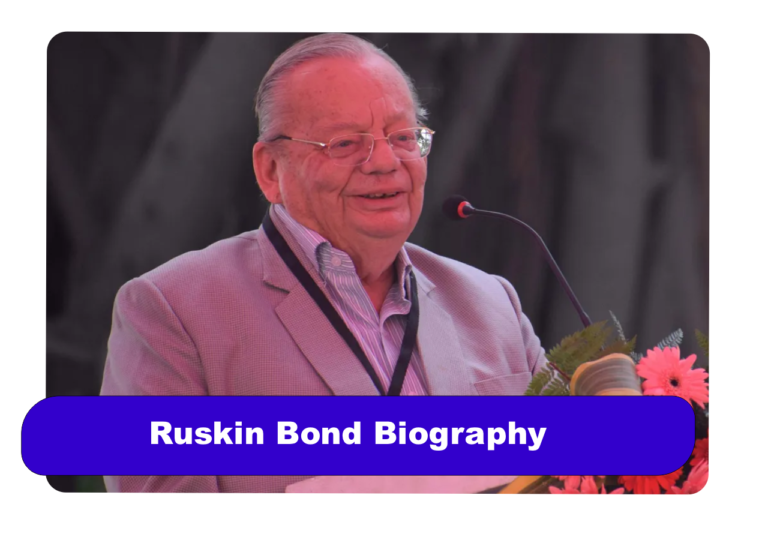
Ruskin Bond is India’s beloved British-Indian literary legend. Discover his age, iconic books, awards, adopted family, net worth, and life in Mussoorie.
Ruskin Bond is one of the most cherished authors in Indian literary history. Born on May 19, 1934, in Kasauli, this British-Indian writer has spent over seven decades crafting stories rooted in the misty Himalayan hills, childhood innocence, and the quiet beauty of nature.
With more than 500 short stories, essays, novels, and poems to his name, he has earned a permanent place in the hearts of readers across generations. Now 92 years old, Bond remains remarkably active. He published three new books in 2025 — Life’s Magic Moments, How To Be You, and Another Day in Landour — and continues to meet fans at his favourite haunt, the Cambridge Book Depot in Mussoorie. Few writers in the world can claim seven decades of continuous literary output, and fewer still can claim to be loved as deeply and widely as Ruskin Bond.
Quick Facts About Ruskin Bond
| Detail | Information |
|---|---|
| Full Name | Ruskin Bond |
| Date of Birth | May 19, 1934 |
| Age | 92 years old (as of 2026) |
| Birthplace | Kasauli, Punjab States Agency, British India |
| Nationality | British-Indian |
| Profession | Author, Poet |
| Net Worth | Estimated $5 million (approx. ₹41 crore) |
| Marital Status | Never married |
| Children | None (lives with adopted family) |
| Education | Bishop Cotton School, Shimla |
| Famous For | The Room on the Roof, The Blue Umbrella, A Flight of Pigeons |
| Residence | Ivy Cottage, Landour, Mussoorie, Uttarakhand |
Early Life: Childhood Across the Hills
Ruskin Bond was born on May 19, 1934, in Kasauli, in what was then British India. His father, Aubrey Alexander Bond, was a Royal Air Force officer who had previously taught English to the princesses of the Jamnagar Palace. His mother, Edith Clarke, was English. The family moved frequently across hill stations, and young Ruskin spent his earliest years in Kasauli and Jamnagar before the family relocated to Dehradun. When Ruskin was just ten years old, his father died of malaria — a loss that left a profound mark on him.
His mother later remarried a Punjabi man, and the household dynamic changed significantly. Ruskin was closer to his father than anyone else, and that grief, combined with a sense of solitude during his formative years, channelled itself powerfully into his writing. The hills, the trees, and the small-town characters around him became both refuge and muse. He also has a sister, Ellen Bond, who sadly passed away in 2014, and a brother, William Bond, who lives in Canada. Despite the fractured family circumstances of his childhood, Bond has spoken warmly about the landscape and communities of the Indian hills that raised him — communities that became the soul of his fiction.
Education: Bishop Cotton School and a Literary Awakening
Ruskin Bond completed his schooling at the prestigious Bishop Cotton School in Shimla, one of India’s oldest residential schools. It was here that his love for literature took root. He was a quiet, reflective student, known more for his pen than his prowess on the playing field.
He won the school’s Irwin Divinity Prize and the Hailey Literature Prize, early signs of the literary genius that would define his life. At just 16, he wrote one of his first short stories, Untouchable, demonstrating both moral courage and narrative maturity beyond his years. After graduating in 1950, Bond made his way to London in search of broader horizons, briefly attended the University of London, and began working on his first novel — the book that would change his life.
Literary Career: From Debut Novel to National Icon
Bond’s debut novel, The Room on the Roof, was written while he was a teenager in London and published in 1956. The semi-autobiographical story of Rusty, a sixteen-year-old Anglo-Indian boy longing for freedom in Dehradun, won the John Llewellyn Rhys Prize in 1957 — awarded to a Commonwealth writer under 30. It was a remarkable debut, and it announced the arrival of a voice that was unlike anything Indian literature had seen before.
After returning to India, Bond settled in Dehradun and later Mussoorie, earning his living as a freelance writer. He penned short stories and poems for newspapers and magazines, building a loyal readership one story at a time. His second major novel, A Flight of Pigeons (1978), set during the Indian Rebellion of 1857, was adapted into the acclaimed Hindi film Junoon, produced by Shashi Kapoor. The Blue Umbrella (1980), a gentle tale of a Himalayan girl and a coveted umbrella, was later turned into a National Award-winning film by Vishal Bhardwaj in 2005.
By the 1990s, Bond had become a fixture in Indian school curricula and children’s literature. His short story collection Our Trees Still Grow in Dehra (1992) won the Sahitya Akademi Award, India’s highest literary honour given by its national academy of letters. Over the following decades, he continued to write prolifically — essays, memoirs, ghost stories, nature writing, and humour — making him one of the few authors who could hold the attention of a seven-year-old and a seventy-year-old equally well. Today, Bond has authored more than 100 books and 500 short stories, including 69 books specifically for children. His output is staggering not just in volume but in consistency of quality — a warmth, simplicity, and emotional honesty that has never dimmed across seven decades of writing.
Notable Books and Adaptations
Some of Bond’s most celebrated works include:
- The Room on the Roof (1956) — his debut novel; semi-autobiographical; John Llewellyn Rhys Prize winner
- A Flight of Pigeons (1978) — adapted into the Hindi film Junoon (1978)
- The Blue Umbrella (1980) — adapted into a National Award-winning film (2005)
- Our Trees Still Grow in Dehra (1992) — Sahitya Akademi Award winner
- Angry River (1972) — a beloved children’s classic
- Granny’s Tree Climbing — a fan favourite for younger readers
- Delhi Is Not Far — a poignant novel of love and longing
- Another Day in Landour (2025) — one of his most recent releases
Personal Life: Nature, Solitude, and an Adopted Family
Ruskin Bond never married. In his memoirs and interviews, he has spoken of meaningful personal relationships over the years, but writing and nature have remained the great loves of his life. He has no biological children. Instead, he lives with his adopted family in Ivy Cottage, Landour — a quiet neighbourhood perched above Mussoorie — and considers them his own in every sense that matters. His daily life is a reflection of his writing: simple, unhurried, and deeply connected to the natural world.
He enjoys morning walks in the oak and pine forests around Landour, cups of tea, and long hours of reading and writing. He is known to visit the Cambridge Book Depot in Mussoorie regularly, where readers of all ages queue up to meet him — a ritual that has become almost as iconic as the man himself. Bond’s relationship with the Mussoorie hills is not just residential; it is spiritual. The landscape appears in almost everything he has written. For Bond, the hills are not a backdrop — they are a character, a companion, and a constant source of wonder that has never lost its magic in over nine decades of living among them.
Awards and Recognition
Ruskin Bond’s contributions to Indian literature have been recognised with some of the country’s most prestigious honours.
- John Llewellyn Rhys Prize (1957) — for The Room on the Roof
- Sahitya Akademi Award (1992) — for Our Trees Still Grow in Dehra
- Padma Shri (1999) — India’s fourth-highest civilian award
- Bal Sahitya Puraskar (2012) — by the Sahitya Akademi for children’s literature
- Padma Bhushan (2014) — India’s third-highest civilian award
He has also been recognised by the Indian Council for Child Education for his contribution to the growth of children’s literature in India, and is often referred to as the “Indian William Wordsworth” for his ability to render nature in prose and poetry with rare, luminous clarity.
Net Worth and Earnings
Ruskin Bond’s net worth is estimated at approximately $5 million (around ₹41 crore) as of 2026. His income comes from book royalties, film adaptation rights, publishing contracts, literary festival appearances, and translations of his work into multiple languages. Unlike many public figures of his stature, Bond leads an intentionally modest life. He has no interest in luxury cars, designer labels, or extravagant living. His cottage in Landour, his books, his walks, and his tea are all he has ever needed.
Final Thoughts
Ruskin Bond’s life is, in many ways, the most honest argument for the idea that greatness doesn’t require noise. He never chased celebrity. He didn’t court controversy or build a brand. He simply sat in the hills, watched the world carefully, and wrote about what he saw with love and precision — for over seventy years without pause.
His books have introduced countless Indian children to the joy of reading in English, given adults a way to revisit the innocence of their own childhoods, and offered the world a portrait of India that is neither glamorous nor grim — just quietly, beautifully true. At 92, Ruskin Bond is still writing. That, more than any award or accolade, is the measure of the man.
Frequently Asked Questions
Q1: Who is Ruskin Bond?
Ruskin Bond is a British-Indian author and poet born on May 19, 1934, in Kasauli, India. He is celebrated for works including The Room on the Roof, The Blue Umbrella, and A Flight of Pigeons. With over 500 short stories and 100 books, he is one of India’s most beloved literary figures.
Q2: How old is Ruskin Bond in 2026?
Ruskin Bond is 92 years old as of 2026, having been born on May 19, 1934. He remains active as a writer, publishing three new books in 2025 and continuing to meet readers in Mussoorie.
Q3: Did Ruskin Bond ever get married?
No, Ruskin Bond never married. He has lived with his adopted family in Landour, Mussoorie, for decades and considers them his own. He has no biological children.
Q4: What is Ruskin Bond’s most famous book?
Ruskin Bond’s most famous works include The Room on the Roof (his debut novel), The Blue Umbrella (adapted into an award-winning film), and Our Trees Still Grow in Dehra (which won the Sahitya Akademi Award in 1992).
Q5: What awards has Ruskin Bond won?
Ruskin Bond has received the Sahitya Akademi Award (1992), Padma Shri (1999), Bal Sahitya Puraskar (2012), and Padma Bhushan (2014), among other honours. His debut novel also won the John Llewellyn Rhys Prize in 1957.
Q6: What is Ruskin Bond’s net worth?
Ruskin Bond’s net worth is estimated at around $5 million (approximately ₹41 crore) as of 2026. His wealth comes from book royalties, film adaptations, publishing rights, and literary appearances, though he is known for leading a simple, modest lifestyle.
Q7: Where does Ruskin Bond live?
Ruskin Bond lives in Ivy Cottage in Landour, a quiet neighbourhood above Mussoorie in Uttarakhand, India. He has resided there since 1980 and is closely associated with the hill town, which features prominently throughout his writing.