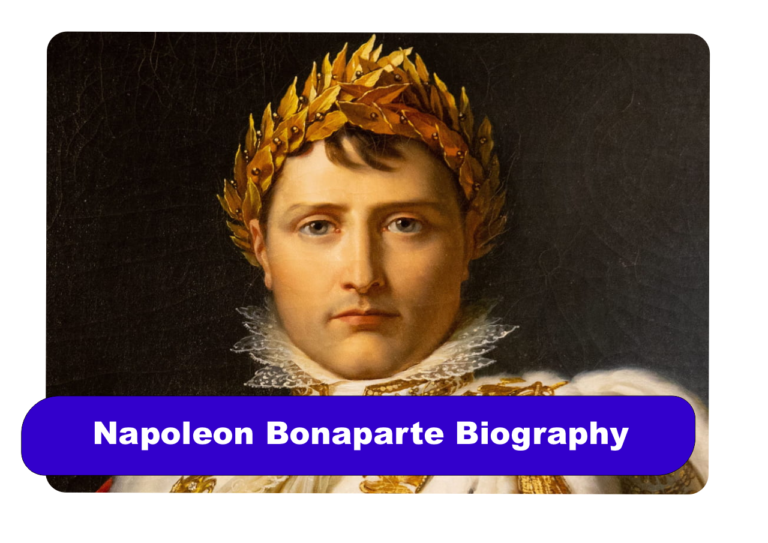
Napoleon Bonaparte was a French military genius and Emperor who conquered Europe. Discover his age, wives, military campaigns, the Napoleonic Code, and controversial legacy.
Napoleon Bonaparte is arguably the most consequential military and political figure in modern Western history. Born a minor Corsican noble in 1769, he rose with astonishing speed through the chaos of the French Revolution to become Emperor of France and master of most of continental Europe.
His campaigns rewrote the rules of warfare, his legal reforms reshaped civilisation, and his eventual downfall became one of history’s great cautionary tales. Two centuries after his death, Napoleon remains a figure of intense fascination. He is studied in military academies, debated by historians, and endlessly portrayed in film and literature. His name has become a byword for both supreme ambition and its limits — a man who remade Europe and was ultimately destroyed by the very drive that created him.
Key Highlights About Napoleon Bonaparte
| Detail | Information |
|---|---|
| Full Name | Napoléon Bonaparte (born Napoleone di Buonaparte) |
| Date of Birth | August 15, 1769 |
| Place of Birth | Ajaccio, Corsica, France |
| Date of Death | May 5, 1821 |
| Age at Death | 51 years old |
| Nationality | French (Corsican-born) |
| Profession | Military General, Emperor of France |
| Reign as Emperor | 1804–1814 and briefly 1815 |
| First Wife | Joséphine de Beauharnais (m. 1796, div. 1809) |
| Second Wife | Archduchess Marie-Louise of Austria (m. 1810) |
| Children | Napoleon II (legitimate); also Charles Léon and Alexandre Colonna-Walewski (illegitimate) |
| Famous For | Napoleonic Wars, Napoleonic Code, French Empire |
| Cause of Death | Stomach cancer (most widely accepted) |
| Buried | Les Invalides, Paris, France |
Early Life: A Corsican Outsider in France
Napoleon was born Napoleone di Buonaparte on August 15, 1769, in Ajaccio, Corsica — just one year after France acquired the island from Genoa. He was the fourth child, and second to survive infancy, of Carlo Buonaparte, a lawyer of ancient Tuscan noble descent, and his wife Letizia Ramolino.
The family was not wealthy, but Carlo was ambitious and politically astute, securing connections at the French royal court that would open doors for his children. Growing up, Napoleon spoke French with a heavy Corsican accent, which made him a target for bullying at school. He compensated by throwing himself into books, excelling particularly in mathematics and history.
He was fiercely proud of his Corsican identity and harboured early sympathies for Corsican independence — a sentiment that would fade as his identity became inseparable from France itself. When his father died of stomach cancer in 1785, sixteen-year-old Napoleon graduated early from the École Militaire in Paris and was commissioned as a second lieutenant of artillery. The responsibility of supporting his family fell on his shoulders almost immediately, forging the relentless self-discipline that would define him for the rest of his life.
Military Education and the French Revolution
Napoleon’s formal education took him through a religious school in Autun, a military academy at Brienne-le-Château, and finally the prestigious École Militaire in Paris. He completed a course that typically took two years in just one, graduating in 1785 at the age of fifteen.
His aptitude for artillery tactics and logistics was evident from the start. The French Revolution of 1789 transformed the world Napoleon was preparing to enter. The old aristocracy that had blocked ambitious men of modest birth was swept away.
Talent and daring now determined advancement. Napoleon recognised the moment for exactly what it was. By 1793, at just 24 years old, his decisive role in the Siege of Toulon — helping recapture the port city from British-backed royalists — earned him promotion to Brigadier General. His career was truly underway.
Rise to Power: From General to Emperor
Napoleon’s Italian campaign of 1796–97 announced him to Europe as a general of the first rank. Commanding a poorly supplied French army, he outmanoeuvred and defeated a succession of Austrian and Piedmontese forces, securing northern Italy for France through audacity and speed. He was 26 years old. His Egyptian campaign of 1798–99, though ultimately inconclusive militarily, burnished his reputation as a commander willing to think on a continental scale. In November 1799, Napoleon staged the coup of 18 Brumaire, seizing political control of France and installing himself as First Consul.
The country, exhausted by a decade of revolutionary turbulence, largely welcomed the stability he offered. He was elected Consul for Life in 1802. Then, on December 2, 1804, in a ceremony of extraordinary theatre at Notre-Dame Cathedral, he crowned himself Emperor of the French — famously taking the crown from Pope Pius VII’s hands and placing it on his own head, a gesture that declared he owed his power to no one but himself.
The Napoleonic Wars: Conquering a Continent
Between 1803 and 1815, the Napoleonic Wars reshaped Europe through a series of conflicts pitting France against shifting coalitions of European powers. Napoleon’s greatest victories came in this period: Austerlitz (1805), considered his tactical masterpiece, destroyed the combined Austrian and Russian armies in a single day. Jena (1806) effectively ended Prussia as a major power in hours.
Wagram (1809) brought Austria to its knees for the second time. At the height of his power around 1810, Napoleon directly controlled or influenced most of continental Europe. He placed his brothers on the thrones of Spain, Naples, and Westphalia and reshaped the map of the continent. Yet the two campaigns that ultimately destroyed him were his own choices. The drawn-out Peninsular War in Spain from 1808, which Wellington would call the “ulcer” that bled France dry, tied down hundreds of thousands of French troops. Then came the catastrophic invasion of Russia in 1812 — 600,000 men marched east; fewer than 100,000 returned.
The Grande Armée was broken beyond repair. Coalition forces entered Paris in 1814, and Napoleon abdicated, accepting exile to the island of Elba. His remarkable instinct for survival saw him escape in 1815, return to France, and reclaim power in what became known as the Hundred Days. But his defeat at the Battle of Waterloo on June 18, 1815, by Wellington and Prussian forces under Blücher, ended his rule permanently. He was exiled to the remote South Atlantic island of Saint Helena, where he would never leave.
Personal Life: Joséphine, Marie-Louise, and Family
Napoleon married Joséphine de Beauharnais in 1796. She was a Martinique-born widow six years his senior, and theirs was one of history’s most turbulent love stories. Napoleon was besotted with her; his letters from campaign are among the most passionate ever written by a head of state.
However, Joséphine could not provide him with an heir, and Napoleon divorced her in 1809 — reportedly uttering her name as one of his final words on Saint Helena, over a decade later. In 1810, Napoleon married Archduchess Marie-Louise of Austria, daughter of the Austrian emperor. The political marriage achieved its dynastic purpose: in 1811, Marie-Louise gave birth to Napoleon II, whom Napoleon immediately named King of Rome.
The boy would never rule France and died at just 21 years old. Napoleon also fathered at least two acknowledged illegitimate sons — Charles Léon with Eléonore Denuelle and Alexandre Colonna-Walewski with the Polish noblewoman Marie Walewska — whom he provided for financially. He remained devoted to his family throughout his life, appointing siblings to thrones and creating one of history’s most nepotistic dynastic systems.
The Napoleonic Code: His Most Enduring Achievement
Napoleon himself believed that his greatest legacy was not any battle won but the Napoleonic Code, promulgated on March 21, 1804. Before its creation, France operated under a patchwork of over 300 different legal systems varying by region.
The Code unified French law under a single rational, written framework founded on Enlightenment principles: equality before the law, protection of property rights, freedom of religion, and the abolition of feudal privilege. Napoleon was correct in his prediction. The Code was adopted across much of Europe — Belgium, Italy, Poland, the Netherlands, and parts of Germany — and its influence crossed the Atlantic, forming the legal backbone of Louisiana’s civil code following the 1803 Louisiana Purchase.
Today, more than half of the original 1804 articles remain active in France, and the Code continues to form the basis of civil law in dozens of countries worldwide. It was not without flaws. The Code entrenched patriarchal authority, granting husbands extensive legal control over wives and children, and rolled back certain rights women had gained during the Revolution. These provisions would shape gender inequality in law for over a century. Napoleon’s legacy in this respect remains a point of serious historical criticism.
Exile, Death, and the Mystery That Remains
After Waterloo, Napoleon surrendered to the British and was exiled to Saint Helena, a volcanic island in the South Atlantic roughly 1,200 miles from the nearest landmass. He spent the final six years of his life there, dictating his memoirs and carefully constructing his own legend — the narrative of a reforming, enlightened ruler undone by the jealousy of monarchies rather than his own overreach.
He died on May 5, 1821, at the age of 51. His physicians attributed his death to stomach cancer, likely aggravated by bleeding gastric ulcers — the same disease that killed his father. However, a 1961 analysis of a sample of his hair detected elevated arsenic levels, fuelling persistent theories of deliberate poisoning, potentially by his British captors or a French royalist.
The debate has never been definitively settled. Napoleon had requested burial “on the banks of the Seine, among the French people I have loved so much.” His wish went unheeded for nearly two decades. In 1840, his remains were finally returned to France and interred in a grand crypt at Les Invalides in Paris, where they rest today beneath one of the most visited tombs in the world.
Final Thoughts
Napoleon Bonaparte compresses into a single lifetime a story that seems too large for any one person: the outsider who conquered a continent, the revolutionary who became a monarch, the legal reformer who entrenched inequality, the military genius who destroyed his own army.
He is simultaneously a figure of inspiration and a warning — proof of what extraordinary will and intelligence can build, and what hubris and unchecked ambition will inevitably bring down. His shadow over the modern world is longer than almost any other individual in history.
The legal systems of dozens of nations, the shape of European borders, the very concept of meritocracy in public life — all bear his fingerprints. Military strategy as it is taught today was profoundly shaped by the campaigns he ran two centuries ago. Whatever verdict history renders on Napoleon the man, Napoleon the phenomenon remains irreducible and irresistible. As he himself once said: “The only way to lead people is to show them a future: a leader is a dealer in hope.”
Frequently Asked Questions
Q1: Who was Napoleon Bonaparte?
Napoleon Bonaparte was a French military general and Emperor born on August 15, 1769, in Ajaccio, Corsica. He rose from relatively modest origins to conquer most of continental Europe before being defeated and exiled. He died on May 5, 1821, on the island of Saint Helena at the age of 51.
Q2: What is Napoleon Bonaparte most famous for?
Napoleon is most famous for his military genius during the Napoleonic Wars, his proclamation as Emperor of France in 1804, and the Napoleonic Code — a legal framework that continues to influence civil law systems across Europe, Latin America, and beyond. He is widely regarded as one of the greatest military commanders in history.
Q3: How did Napoleon Bonaparte die?
Napoleon died on May 5, 1821, at age 51 on the island of Saint Helena. The most widely accepted cause of death is stomach cancer, aggravated by bleeding gastric ulcers. A competing theory suggests arsenic poisoning, based on elevated arsenic levels found in hair samples analysed in 1961, though this remains contested among historians.
Q4: Who were Napoleon’s wives?
Napoleon married twice. His first wife was Joséphine de Beauharnais, whom he married in 1796 and divorced in 1809 because she could not produce an heir. His second wife was Archduchess Marie-Louise of Austria, whom he married in 1810. Marie-Louise gave birth to his only legitimate son, Napoleon II, in 1811.
Q5: Was Napoleon really short?
No — this is one of history’s most persistent myths. Napoleon stood approximately 5 feet 7 inches (1.68 metres) tall at the time of his death, which was above average for a French man of his era. The myth likely arose from a misunderstanding between French and British inch measurements and from British wartime caricatures designed to belittle him.
Q6: What was the Napoleonic Code?
The Napoleonic Code, promulgated in 1804, was a comprehensive civil law code that unified France’s fragmented legal systems under a single rational framework. It enshrined equality before the law, property rights, and freedom of religion. Napoleon considered it his greatest achievement, and it remains the foundation of civil law in dozens of countries worldwide.
Q7: Where is Napoleon Bonaparte buried?
Napoleon is buried in a grand crypt at Les Invalides in Paris, France. He died on Saint Helena in 1821 and was originally buried on the island per British insistence, despite his wish to be interred on the banks of the Seine. His remains were returned to France in 1840 and have rested at Les Invalides ever since.