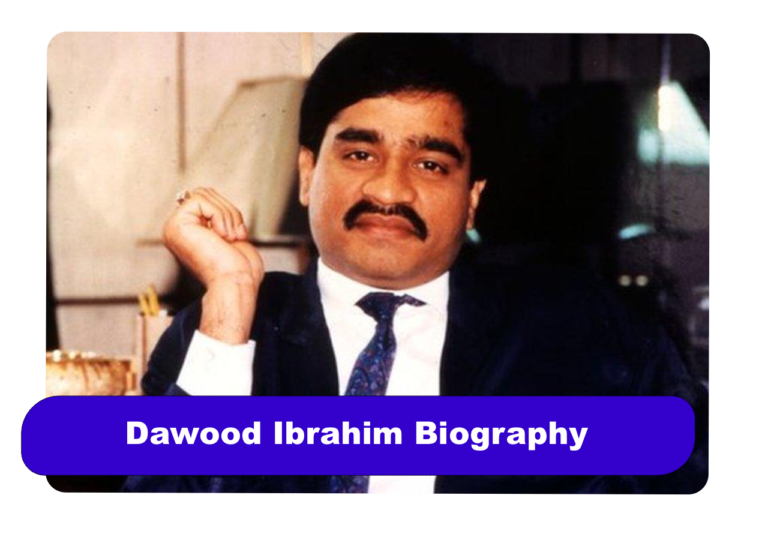
Dawood Ibrahim is India’s most wanted fugitive and global terrorist. Explore his age, net worth, wife, D-Company crimes, and 1993 Mumbai bombings in this biography.
Dawood Ibrahim Kaskar is arguably the most notorious criminal figure to ever emerge from India. Born into a modest Mumbai family — ironically the son of a police constable — he built one of the most powerful and feared crime syndicates in the world, known simply as D-Company.
His name has been linked to murder, extortion, drug trafficking, arms smuggling, terrorism, and the deadliest peacetime attack ever carried out on Indian soil. For over three decades, Dawood has lived as a fugitive. Wanted by India, the United States, Interpol, and the FBI, he is believed to be sheltering in Karachi, Pakistan — though Pakistan has consistently denied his presence on its soil. His story is not one of inspiration, but of ruthless ambition and irreversible destruction.
Quick Facts About Dawood Ibrahim
| Detail | Information |
|---|---|
| Full Name | Dawood Ibrahim Kaskar |
| Date of Birth | December 26, 1955 |
| Age | 69 years old (as of 2025) |
| Birthplace | Khed, Ratnagiri, Maharashtra, India |
| Nationality | Indian (fugitive) |
| Profession | Organized crime boss, terrorist (designated) |
| Estimated Net Worth | ~$6.7 billion (estimated) |
| Syndicate | D-Company |
| Wife | Zubeena Zareen (also referred to as Mehjabeen) |
| Children | Moin Ibrahim, Mahrukh Ibrahim, Mahreen Ibrahim, Maria Ibrahim |
| Education | Dropped out of Ahmed Sailor High School, Mumbai |
| Famous For | 1993 Mumbai bombings, founding D-Company, global fugitive status |
| Current Status | Fugitive; wanted by India, USA, Interpol, and FBI |
Early Life: The Constable’s Son from Dongri
Dawood Ibrahim was born on December 26, 1955, in Khed, Ratnagiri district of Maharashtra, into a Konkani Muslim family. His father, Ibrahim Kaskar, served as a head constable with the Mumbai Police — a detail that lends a particularly stark irony to the story that follows. His mother, Amina Bi, was a homemaker. The family later moved to Dongri, a densely populated neighbourhood in south Mumbai historically known for its exposure to underworld activity.
Growing up in Dongri in the 1960s and 70s, Dawood was surrounded by street crime and gang culture from a young age. He dropped out of Ahmed Sailor High School during his teenage years and gravitated quickly toward petty crime — theft, street-level fraud, and forced recovery.
He caught the attention of local criminal figures and began moving through the lower rungs of Mumbai’s underworld, learning its structure, codes, and opportunities. His early mentor figures included local gangsters who introduced him to the world of smuggling, particularly the highly lucrative black market for gold and electronics that thrived during India’s era of strict import controls. It was a world that rewarded ruthlessness, and Dawood had it in abundance.
Rise Through the Mumbai Underworld
In the late 1970s, Dawood and his brother broke away from the local gang they had been operating under and established what would eventually become D-Company. The syndicate began its operations in smuggling — gold, electronics, and contraband goods — capitalising on the import restrictions that made such black market trade enormously profitable in India at the time.
Following his brother’s death during a violent gang conflict, Dawood assumed sole control of the organisation. Under his leadership, D-Company expanded rapidly and ruthlessly. By the early 1980s, the syndicate had grown to dominate Mumbai’s underworld, with operations extending into extortion, contract killings, gambling, and narcotics. Rival gangs were either absorbed or eliminated.
Dawood’s reputation for swift, merciless retaliation kept law enforcement at bay and competitors in fear. His influence also crept into legitimate industries — most notably Bollywood, where D-Company’s control over film financing and distribution became an open secret in the 1980s and 90s. Extortion of film stars and producers was widespread. The line between Mumbai’s entertainment industry and its underworld had never been blurrier.
Fleeing India and Building a Global Empire
Facing escalating legal pressure, including murder charges related to the killing of a rival gang member, Dawood fled India in 1986 using forged passports. He relocated to Dubai, where he established a significant base of operations, acquiring properties and operating under multiple aliases — including “Sheikh Dawood Hassan.” From Dubai, he directed D-Company’s international expansion into the Middle East, Africa, and Europe.
By the late 1980s and early 1990s, D-Company had evolved from a regional crime syndicate into a truly global criminal enterprise. Operations now spanned drug trafficking, arms smuggling, money laundering, counterfeit currency, and contract killings across multiple continents. The group forged alliances with international criminal networks and, increasingly, with jihadist organisations — a shift that would define Dawood’s legacy forever.
The 1993 Mumbai Bombings: Terrorism on an Unprecedented Scale
On March 12, 1993, a series of 13 coordinated bomb explosions tore through Mumbai in a single day. The blasts targeted the Bombay Stock Exchange, Air India building, hotels, and crowded markets. When the smoke cleared, over 250 people were dead and more than 700 were injured.
It remains the deadliest terrorist attack in Indian history. Indian authorities and subsequent investigations concluded that Dawood Ibrahim was the primary mastermind behind the bombings, allegedly orchestrated in retaliation for the demolition of the Babri Masjid mosque in December 1992. D-Company had used its smuggling routes to transport the RDX explosives used in the attacks.
The bombings were coordinated with the involvement of Pakistan’s Inter-Services Intelligence (ISI), according to Indian intelligence reports. In the aftermath, Dawood fled Dubai and moved to Karachi, Pakistan, where he is widely believed to have remained ever since under ISI protection. Pakistan has consistently and categorically denied his presence on Pakistani soil, creating a diplomatic flashpoint between the two countries that has persisted for over three decades.
D-Company: A Criminal-Terror Hybrid
D-Company today operates as what analysts describe as a criminal-terror hybrid — a syndicate whose operations fund and intersect with international terrorism. Following the September 11, 2001, attacks, global scrutiny intensified on the organisation’s ties to jihadist networks. Intelligence reports linked D-Company to financing Al-Qaeda operations and to active collaboration with Lashkar-e-Taiba (LeT) and Jaish-e-Mohammed (JeM), two Pakistan-based terrorist organisations.
In October 2003, the United States designated Dawood Ibrahim a Specially Designated Global Terrorist, with the U.S. Treasury citing his role in sharing smuggling routes with Al-Qaeda and funding Islamic extremist attacks aimed at destabilizing the Indian government. In 2006, he was further designated a Significant Foreign Narcotics Trafficker. He was listed third on Forbes’ World’s 10 Most Wanted list from 2010 until the publication discontinued the list in 2011. Today, D-Company’s two main factions are reportedly led by his deputy Chhota Shakeel and his brother Anees Ibrahim.
Personal Life: Family and the Shadow of Crime
Dawood Ibrahim is married to Zubeena Zareen (also referred to in some sources as Mehjabeen), and together they have four children: Moin, Mahrukh, Mahreen, and Maria Ibrahim. In 2006, his daughter Mahrukh married Junaid Miandad, the son of legendary Pakistani cricketer Javed Miandad — a union that drew enormous media attention and further entangled Dawood’s personal life with geopolitical controversy.
His son Moin Ibrahim reportedly lives in Karachi, where he has memorised the Quran and works as a religious teacher. Moin is said to be deeply critical of his father’s criminal activities — a poignant footnote in an otherwise dark family narrative. Several of Dawood’s siblings, including his brother Iqbal Kaskar, remained in Mumbai. Iqbal has faced multiple arrests by Indian authorities in connection with money laundering and extortion cases.
Estimated Net Worth and Criminal Wealth
Given the clandestine nature of his operations, no verified figure for Dawood Ibrahim’s net worth exists. Estimates place it at approximately $6.7 billion, which would rank him among the wealthiest criminal figures in recorded history — fifth on several published lists of the world’s richest criminals.
His wealth is spread across real estate holdings in India, Dubai, and other locations, as well as businesses and investments used to launder proceeds from drug trafficking, extortion, gambling, and arms smuggling. The United States government has offered a $25 million bounty for information leading to his capture. India’s National Investigation Agency (NIA) has separately offered a reward for information on his whereabouts. Despite these incentives and decades of international pursuit, he has never been apprehended.
Current Status: India’s Most Wanted
As of 2026, Dawood Ibrahim remains one of the world’s most wanted fugitives. Indian intelligence has consistently maintained he is living in Karachi, Pakistan, citing intercepted communications and the testimonies of arrested associates. He is subject to an Interpol Red Notice and is wanted by the FBI for terrorism and narcotics charges. Law enforcement agencies across India, the UK, the UAE, and the United States have spent decades attempting to dismantle D-Company’s financial and operational networks.
Recent years have seen progress in this effort. Indian agencies have secured extraditions of several D-Company operatives from the Middle East and South Asia. Properties belonging to Dawood and his family in India have been seized and auctioned by the Enforcement Directorate. In 2025, multiple associates linked to the syndicate’s drug trafficking and money laundering networks were arrested in Mumbai, the UK, and Dubai.
Conclusion
Dawood Ibrahim’s life is a testament to the catastrophic scale of destruction that organised crime, when left unchecked, can achieve. From the streets of Dongri to the boardrooms of a billion-dollar criminal empire, his trajectory was built on violence, fear, and the exploitation of every institutional weakness he encountered.
The 1993 Mumbai bombings remain his most defining act — one that killed hundreds of innocent people and permanently redefined India’s relationship with terrorism. He has now evaded capture for over 40 years. Governments have changed, geopolitics have shifted, and the world has been transformed — yet Dawood Ibrahim remains at large, a living symbol of impunity.
His story serves as a sobering reminder of the long shadow that organised crime and terrorism cast, and of the urgent, unfinished business of international justice.
Frequently Asked Questions
Q1: Who is Dawood Ibrahim?
Dawood Ibrahim Kaskar is an Indian organised crime boss and globally designated terrorist, born on December 26, 1955, in Ratnagiri, Maharashtra. He founded D-Company, one of the most powerful criminal syndicates in the world, and is the primary accused in the 1993 Mumbai serial bombings that killed over 250 people.
Q2: Where is Dawood Ibrahim now?
Indian intelligence agencies believe Dawood Ibrahim is currently living in Karachi, Pakistan, under the protection of Pakistani state actors. Pakistan has consistently denied his presence on its soil. His exact whereabouts remain officially unconfirmed as of 2026.
Q3: What is D-Company?
D-Company is the organised crime syndicate founded by Dawood Ibrahim in Mumbai in the late 1970s. It has evolved into a global criminal-terror network involved in drug trafficking, arms smuggling, extortion, money laundering, and links to international terrorist organisations including Al-Qaeda and Lashkar-e-Taiba.
Q4: What is Dawood Ibrahim’s net worth?
Dawood Ibrahim’s estimated net worth is approximately $6.7 billion, though this figure is speculative given the hidden nature of his assets. His wealth is accumulated through decades of drug trafficking, extortion, real estate, and other criminal enterprises spread across multiple countries.
Q5: Why was Dawood Ibrahim designated a global terrorist?
In 2003, the United States designated Dawood Ibrahim a Specially Designated Global Terrorist for his role in the 1993 Mumbai bombings, his use of smuggling routes to support Al-Qaeda, and his financing of Lashkar-e-Taiba attacks. In 2006, he was also designated a Significant Foreign Narcotics Trafficker.
Q6: Who is Dawood Ibrahim’s wife?
Dawood Ibrahim is married to Zubeena Zareen (also referred to as Mehjabeen in some reports). The couple have four children: Moin, Mahrukh, Mahreen, and Maria Ibrahim. His daughter Mahrukh married Junaid Miandad, son of Pakistani cricket legend Javed Miandad, in 2006.
Q7: Has anyone been arrested in connection with the 1993 Mumbai bombings?
Yes. Several co-accused have been tried and convicted in India over the decades. However, Dawood Ibrahim himself, designated the primary mastermind, has never been brought to trial and remains a fugitive. His close associate Tiger Memon is also still at large.